
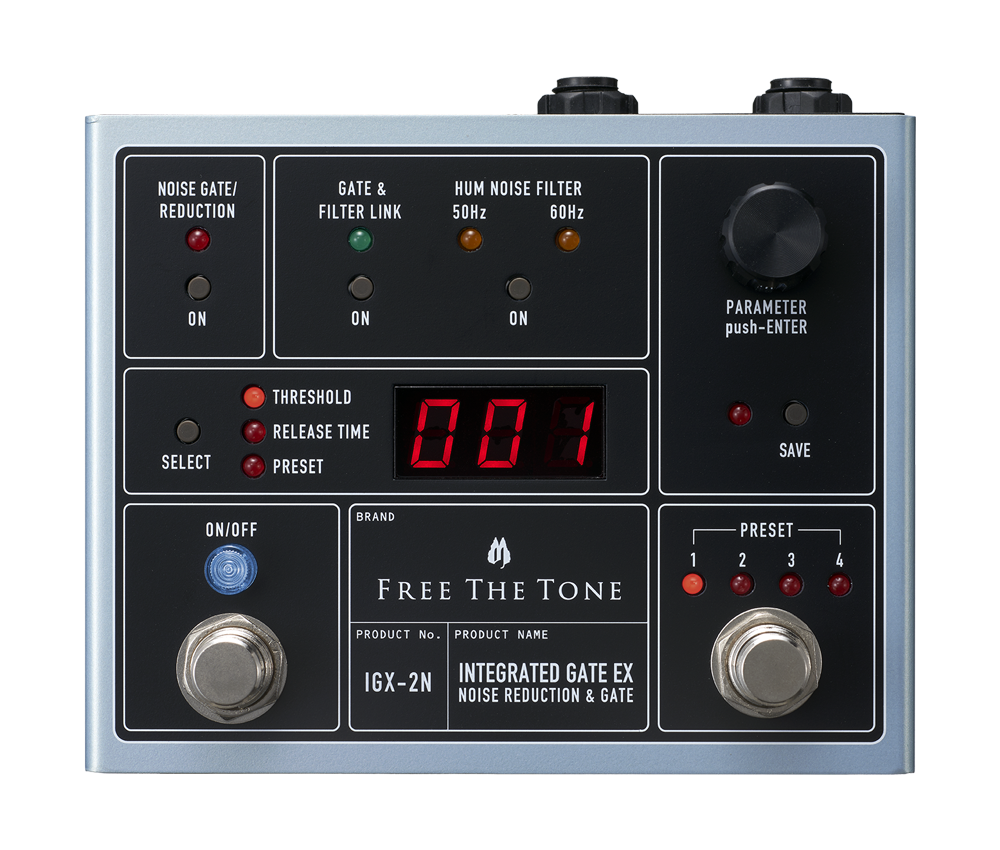
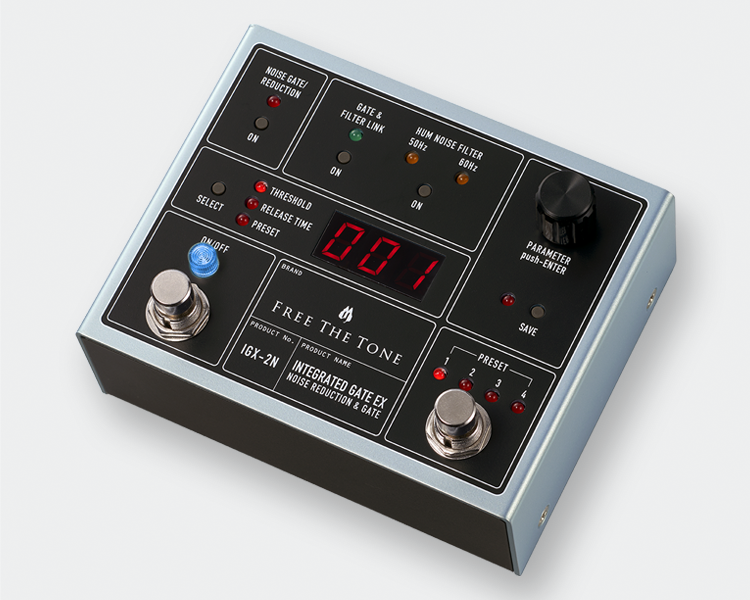
| Model | INTEGRATED GATE EX / IGX-2N |
|---|---|
| Type | NOISE REDUCTION & GATE |
| Manual |
INTEGRATED GATE EX / IGX-2N Manual |


The INTEGRATED GATE EX is a new-gen noise reduction pedal, equipped with a newly developed hum noise filter. For the optimal sound quality, and latency free experience, the signal stays completely analog from the input to the output.
Its CPU monitors the input signal constantly, and this allows the optimal noise reduction and the control of the noise gate.
This pedal is capable of storing 128 presets. This will allow you to use the perfect settings for each situation depending on the other pedals, gain of the amp, and your instruments.
Inspiration for Noise Reduction Development
Noise picked up by guitar and bass pickups has long been a problem for musicians, recording/FOH engineers, and electrical engineers. In recent years, it is said that the amount of noise picked up by pickups has increased due to the spread of personal computers, LED light bulbs, cellular phones, and wireless devices. The type of noise varies from a low booming buzz to a very high shrill noise, depending on the location. In a severe situation, it may interfere with your guitar or bass playing. To make the noise less noticeable, the volume can be turned down quickly or muted with a volume pedal or switching system, but a limit is soon reached with such methods because there are often many different phrases and tunes to be played making it difficult to also deal with noise problems. We have received many inquiries about how to reduce noise, especially that picked up by pickups on stage and how to create an environment in which the player can concentrate on the performance.
Efforts to Reduce Noise
There are several ways to reduce the noise picked up by pickups, such as employing noise-canceling pickups or improving the shielding effect of the guitar or bass itself, but all of them change the sound quality of the output from the instrument. In addition, the amount and bandwidth of the required noise reduction can vary, and its effect is often limited. Alternatively, a high-cut filter can be used to make the noise less noticeable, but that will change the important sound quality. We have considered various solutions to reduce noise, and have found that automatically reducing the level of the signal output from the instrument is the best way to preserve both the sound quality and the naturalness of the decay of the instrument’s sound. Turning down the volume with the volume knob on the guitar or a volume pedal – an operation that used to be done manually to make the noise less noticeable, is now performed electronically, automatically, and at high speed.
Measures against Hum Noise
After examining numerous real-world usage examples of the previous gen, INTEGRATED GATE/IG-1N, we found that users typically set the threshold just high enough to eliminate audible hum noise.
Hum noise primarily occupies the low-frequency range, which overlaps with the frequency spectrum of guitar and bass signals. Because it originates from the AC power supply (50 Hz or 60 Hz), it also contains harmonics at integer multiples of the mains frequency. At Free The Tone, we analyzed the frequency components of hum noise using a guitar equipped with single-coil pickups, which are particularly susceptible to hum. Our measurements revealed that the most prominent hum components occur at the 3rd, 5th, and 7th harmonics of the mains frequency. In 50 Hz regions, these correspond to 150 Hz, 250 Hz, and 350 Hz.
To reduce these hum components, we developed a circuit incorporating three notch filters whose attenuation levels are dynamically controlled by the input signal. Since the unit is designed for use in both 50 Hz and 60 Hz power regions, it allows users to switch between 50 Hz and 60 Hz operating modes. In environments where hum noise is minimal and the hum filter is unnecessary, the filter can simply be turned off.
Fusion of Digital and Analog
In developing the “INTEGRATED GATE EX”, we adopted an approach in which the audio signal line is left in the analog domain without being digitized from the viewpoint of emphasis on sound quality, and the output level is controlled at high speed and accurately by a digital circuit. We have adopted a digitally controlled analog circuit system which is one of our strengths. This technology is also used in our IG-1N(INTEGRATED GATE) and PA-1Q series (Programmable Analog 10-Band EQ).
Signal Monitoring Feature
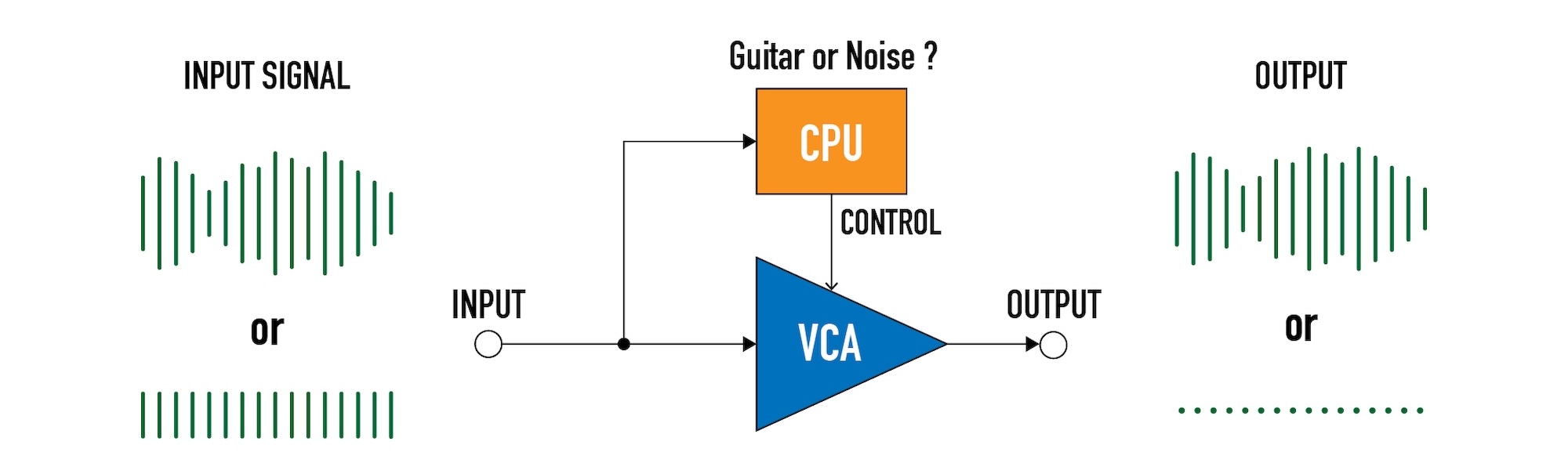
The noise picked up by a pickup becomes more noticeable as the string vibration decays and the volume decreases. The attenuation of the string vibration is not linear, and there are also swells in the vibration, and in reality, while it is gradually attenuating, it is also repeatedly increasing and decreasing in volume. This can cause an unnatural sound at the end of a note when using conventional noise gates. To solve this problem, we have newly developed a signal monitoring function that constantly monitors the input signal by use of a CPU. By constantly monitoring and analyzing the input waveforms, and by performing high-speed control to achieve an optimum output level based on the waveforms, we have succeeded in obtaining natural attenuation.
Two Operating Modes
The “INTEGRATED GATE” has both Noise Reduction and Noise Gate modes.
Noise Reduction Mode
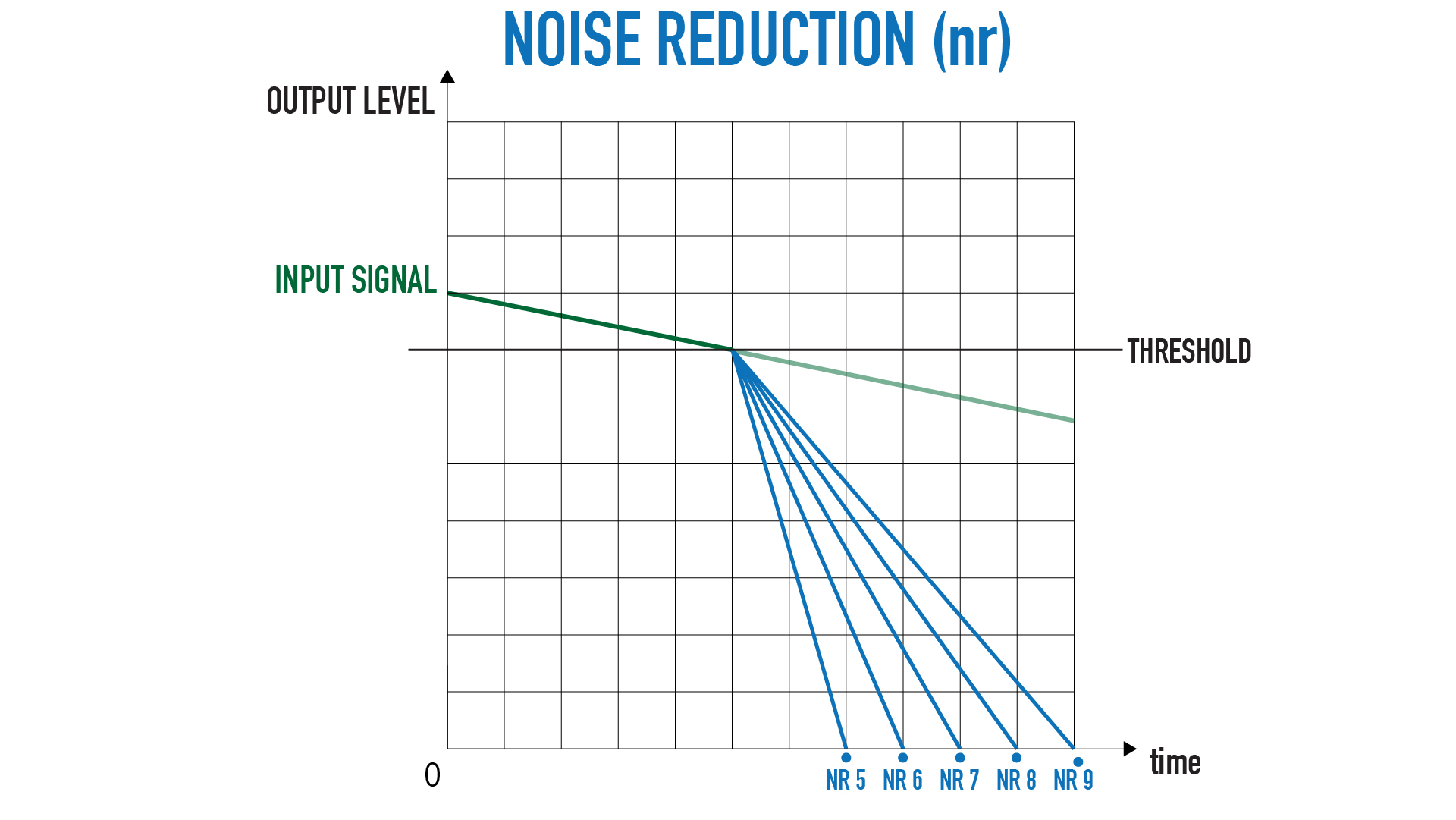
In this mode, the noise reduction circuit starts a gradual reduction of the volume to make the noise less noticeable when the volume drops below the set volume (THRESHOLD value). The Signal Monitoring function provides the best volume control and achieves natural attenuation. When a signal exceeding the set value is received, the noise reduction circuit immediately passes the signal as it is.
Noise Gate Mode
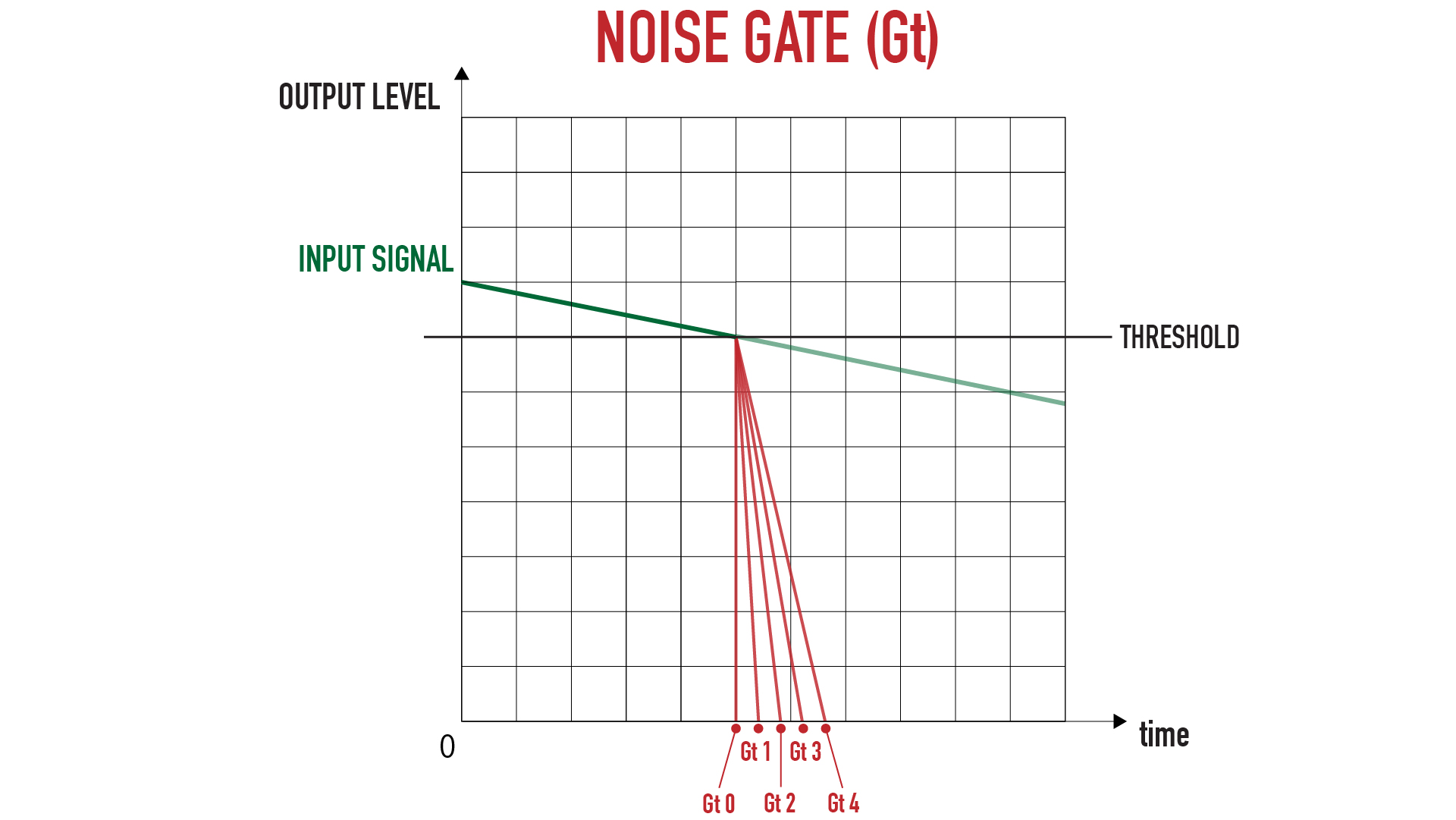
In this mode, the sound is muted immediately when the volume drops below the set volume (THRESHOLD value). This is useful when you want to stop the sound immediately while playing. It can be used as a crisp gate effect.
GATE & FILTER LINK Function
When the GATE & FILTER LINK function is turned ON, the Hum Noise Filter operates in conjunction with the Noise Gate/Noise Reduction circuit. When a guitar or bass signal is detected, the Hum Noise Filter is automatically bypassed, allowing the instrument's signal to pass without compromising its tonal quality.
Line-Level Compatibility
The signal level sent from the effects send of a guitar amplifier's effects loop can vary significantly depending on the amplifier's settings. To accommodate high-level signals, the INTEGRATED GATE EX accepts input levels of up to +19.5 dBu.
Preset Function
The amount and characteristics of noise can vary significantly depending on the guitar, effects pedals, and amplifier gain settings being used. To accommodate different instruments and signal chain configurations, the unit provides 128 preset locations, allowing optimized settings to be stored for each setup. The following parameters can be stored in each preset:
Noise Gate/Reduction ON/OFF, Hum Noise Filter ON/OFF, GATE & FILTER LINK ON/OFF, Threshold, Noise Gate/Noise Reduction mode selection
Presets 1–4 can be recalled instantly using the footswitches on the front panel.
Noise Gate/Reduction ON/OFF, Hum Noise Filter ON/OFF, GATE & FILTER LINK ON/OFF, Threshold, Noise Gate/Noise Reduction mode selection
Presets 1–4 can be recalled instantly using the footswitches on the front panel.
MIDI Function
The unit is equipped with MIDI IN and MIDI OUT/THRU connectors, allowing presets to be recalled and the effect to be turned on or off via MIDI messages.
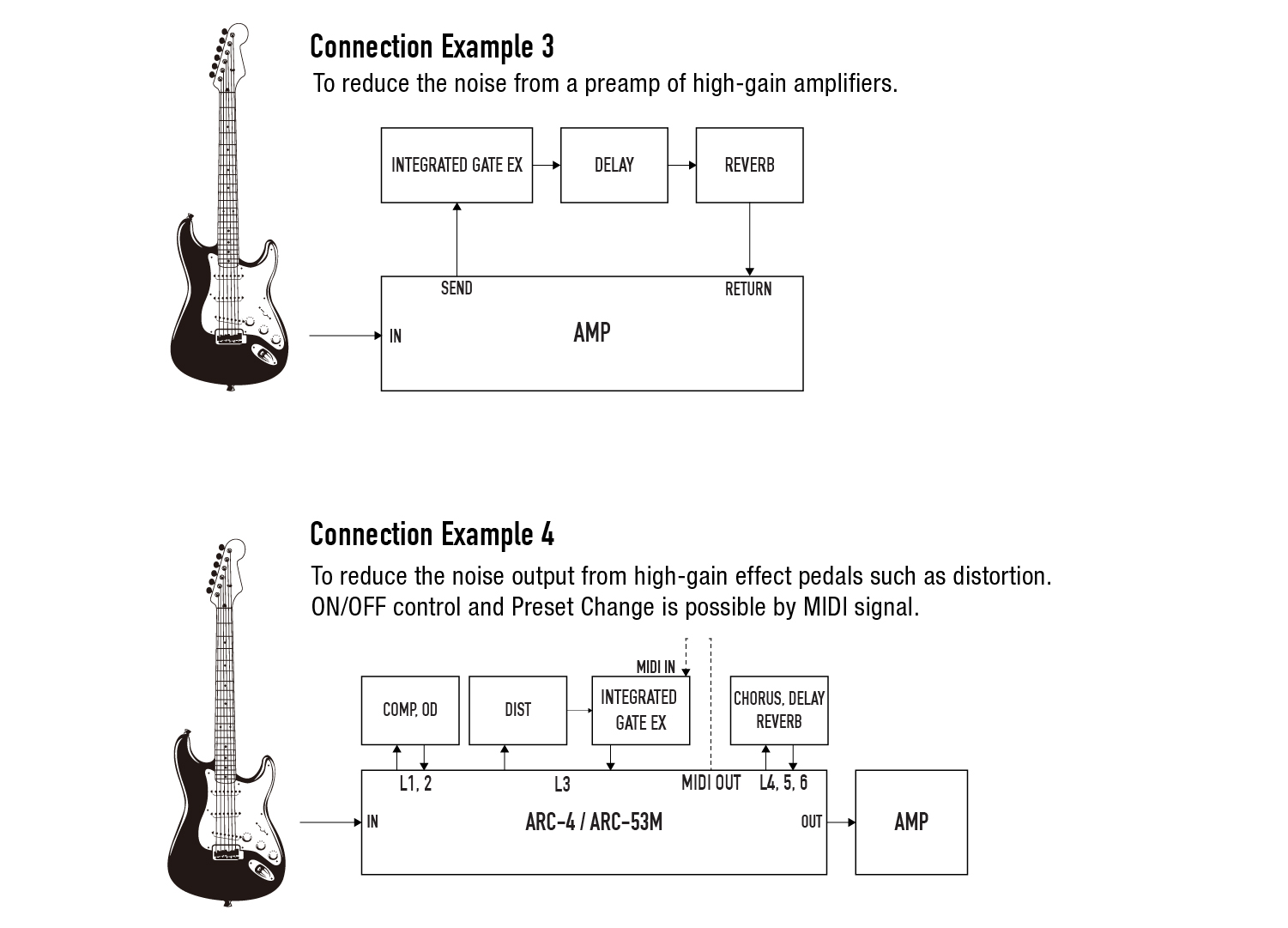
This feature is especially useful when the unit is used together with audio routing controllers such as the ARC-4 or ARC-53M. Since the unit does not need to be connected to an effects loop, it can be easily integrated into a pedalboard without requiring major changes to the wiring.
This feature is especially useful when the unit is used together with audio routing controllers such as the ARC-4 or ARC-53M. Since the unit does not need to be connected to an effects loop, it can be easily integrated into a pedalboard without requiring major changes to the wiring.
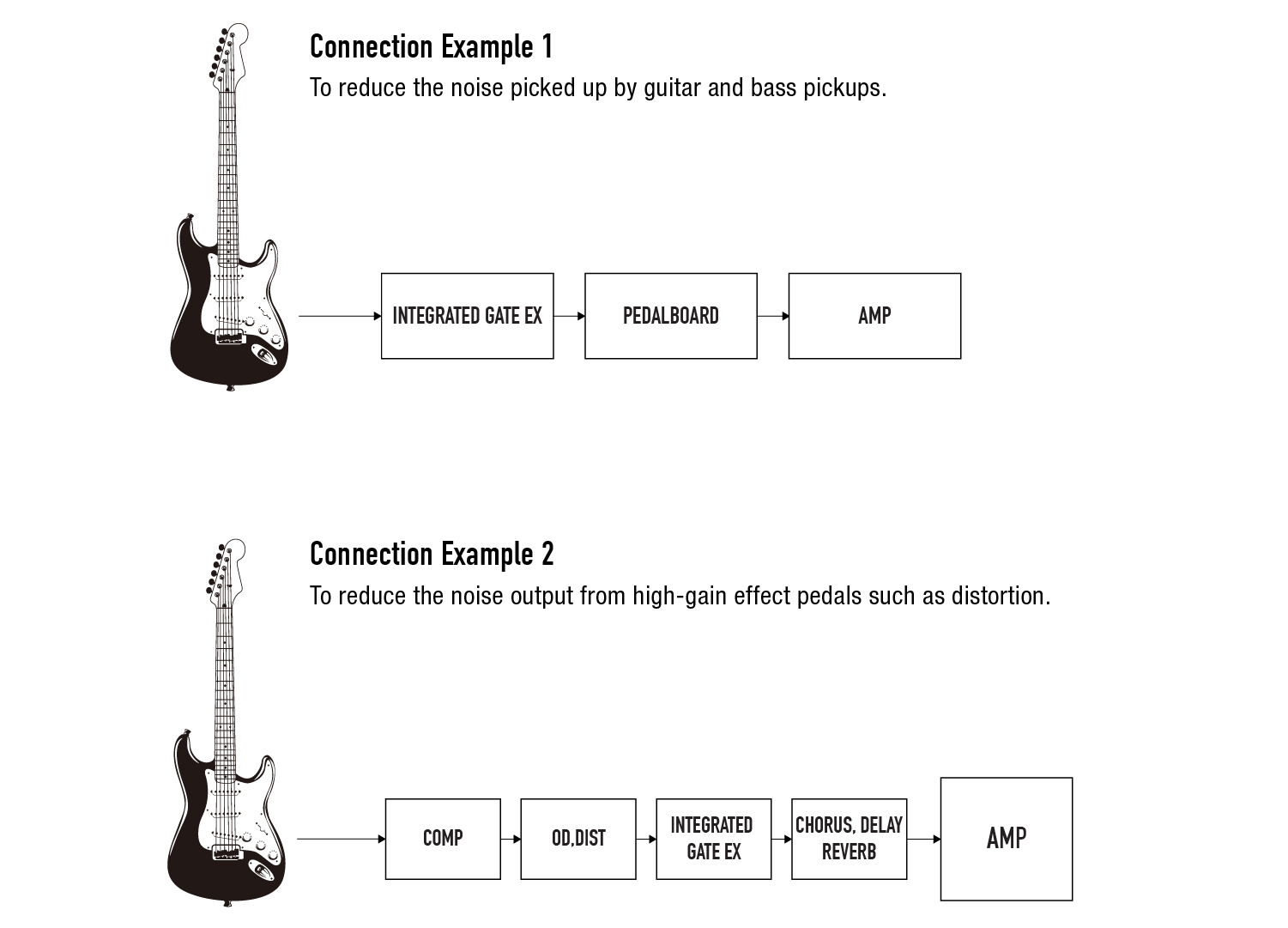
Connection Examples
Comparison between the IG-1N and the IGX-2N
| IG-1N | IGX-2N | |
|---|---|---|
| HTS Circuit | ◯ | ◯ |
| Noise Gate・Mode | ◯ | ◯ (5 operation mode available) |
| Noise Reduction・Mode | ◯ | ◯ (5 operation mode available) |
| Hum Noise Filter | ー | ◯ (Available both in 50Hz/60Hz) |
| Preset Function | ー | ◯ (128 presets) |
| Maximum Input Level | +15dBu | +19.5dBu (INST/LINE switch) |
| Battery Operation | ◯ | ー |
| MIDI Function | ◯ (Only ON/OFF by CC messages) | ◯ |